

Choosing addiction counseling is not only about finding the closest office. The right starting point includes checking credentials, understanding whether individual or group support fits your needs, and asking how a provider responds if your care needs change. If you are searching locally, CenterPointe’s Sarasota service area is one place to review the setting before you call. A thoughtful search can make the first conversation feel more manageable.
When evaluating an addiction counselor near me sarasota, verify the counselor’s current license or certification, ask about experience with your concerns, and discuss individual versus group options. SAMHSA notes that education and credential requirements vary, so confirm current information with the relevant credentialing entity: SAMHSA guidance.
Before comparing providers, it helps to understand what addiction counselors do, how their work supports recovery, and when they may coordinate with other professionals. That context gives you better questions to ask when exploring Sarasota service options.
What Does an Addiction Counselor Do?
An addiction counselor helps people understand how substance use is affecting their health, relationships, work, and daily life. The role is not limited to giving advice. Depending on the counselor’s training, setting, and credential, support may include discussing concerns, completing an assessment, and developing treatment goals. It may also include providing counseling, teaching recovery skills, coordinating services, and making referrals when another level of care or specialized support is needed.
SAMHSA describes addiction counselors as professionals who advise people about substance use and substance use disorders. Counselors may work in treatment facilities, mental-health or community health centers, and private practices. Their responsibilities can include treatment planning, education, documentation, ethical practice, and culturally responsive care. The specific scope of practice depends on the person’s education, license, certification, employer, and state requirements.
People sometimes use the words counselor and therapist interchangeably, but the titles do not always mean the same thing. A therapist may provide psychotherapy for mental-health concerns, while an addiction counselor may focus more directly on substance-use concerns and recovery support. There can be meaningful overlap, especially when care addresses both substance use and co-occurring mental-health needs. Rather than relying on a title alone, ask what the professional is licensed or certified to do, what concerns they treat, and how they coordinate care when needs change.
Education and credential requirements also vary. SAMHSA notes that requirements can range from a high school diploma or GED to a graduate degree, and recommends checking current information with the relevant credentialing entity. A thoughtful search for an addiction counselor near me Sarasota should therefore consider training, experience, treatment approach, communication style, and whether the setting offers the level of outpatient support that fits your situation.
How to Find an Addiction Counselor Near Me in Sarasota
Finding an addiction counselor near me in Sarasota can start with a local search, but proximity is only the first filter. Addiction counselors work in treatment facilities, mental-health and community-health centers, and private practices. Compare the type of support offered, the counselor’s current credentials, and whether the setting matches the level of care you are considering.
A practical search process can help:
- Start with reliable local sources. Use SAMHSA’s treatment locator to identify options, then review each provider’s own website for its location, services, clinical team, and contact information.
- Confirm the Sarasota connection. Check whether the office is convenient for your routine and whether the provider serves Sarasota clients in the format you need. CenterPointe’s Sarasota service area information can help you understand its local setting.
- Look beyond the map pin. Ask whether the counselor works with substance-use concerns, how care is structured, and how referrals or coordination are handled when needs change. A nearby office is not automatically the right fit.
- Contact the provider with specific questions. Ask who would provide care, what credentials and relevant experience they hold, which formats may be available, and what information is needed to discuss next steps. Do not assume that a search result or directory listing reflects current availability.
CenterPointe is an outpatient addiction and mental-health treatment provider based in Sarasota. Its services include individual and group therapy and an intensive outpatient program, but the appropriate option depends on a person’s circumstances and should be discussed directly with the provider. This broader evaluation approach is different from choosing a single provider profile or simply reading a general counseling overview. It helps you compare local options based on fit, scope, and practical access rather than distance alone.
How Do You Verify an Addiction Counselor’s Credentials in Florida?
Use a short verification process before choosing care. Credentials can help you understand a provider’s training and legal scope, but no single license or certification guarantees that a counselor is the right fit for your needs.
- Identify the credential and education. Ask what degree, license, certification, or supervised training the counselor has completed. Education requirements for addiction counselors vary widely, from a high school diploma or GED to a graduate degree, so ask the provider to explain what their specific credential represents.
- Distinguish a license from a certification. A state agency generally issues a license, which grants legal authority to practice an occupation. A professional organization or other nongovernmental body awards a certification, which is not typically legal permission to practice independently. These credentials can serve different purposes, so do not treat the terms as interchangeable. SAMHSA’s credential overview provides useful background.
- Check the current record. Ask which Florida credentialing entity maintains the record, then confirm the license or certification is current through that entity. SAMHSA advises checking directly with the credentialing organization for the most up-to-date information. Also ask whether the provider practices under supervision or within a larger clinical team.
- Review relevant experience and scope. Ask how the counselor works with substance-use concerns, co-occurring mental-health needs, family concerns, relapse prevention, or referrals. SAMHSA describes competencies such as assessment, treatment planning, counseling, coordination, documentation, ethics, and cultural competency. A counselor may be qualified for some needs but not every level of care.
- Ask practical questions before scheduling. Confirm the treatment format, privacy expectations, coordination with other providers, availability, and what happens if your needs require a different or more intensive service. You can review the CenterPointe counseling team as one starting point. Carrie Phelps is identified there as LMHC, LMT, and CST-T, with more than 30 years of experience; those credentials and experience describe Carrie specifically, not every counselor.
Which Questions Help You Assess Counselor Fit?
A counselor’s credentials matter, but fit also depends on how care feels and functions in practice. Before scheduling, ask questions that help you understand the counselor’s approach, communication style, and experience with substance-use and co-occurring mental-health concerns.
- What approach do you use? Ask whether the counselor uses methods such as Motivational Interviewing, CBT, or DBT skills training, and how the approach will be adapted to your goals. Effective care should involve assessment and a treatment plan, not a one-size-fits-all script.
- How do you support people from different backgrounds? Ask how the counselor approaches culture, family expectations, language, identity, spirituality, and other factors that may shape your experience. Cultural responsiveness is part of substance-use counseling competency, according to SAMHSA guidance.
- How do you coordinate care? Find out how the counselor communicates, with your permission, with a primary-care clinician, psychiatrist, family member, or other support. Ask what happens if your needs change or another service becomes appropriate.
- How private are sessions, and what format is available? Clarify confidentiality, its legal limits, in-person or telehealth options, session length, and whether individual, family, or group support may be part of care. Also ask about current availability, scheduling, and what to do if you need help between appointments.
If outpatient counseling is not the right level of support, a responsible provider should explain the concern and help identify an appropriate referral or next step. CenterPointe’s counseling team can be one source of information as you compare local options. Discuss your needs directly, and verify current license and relevant experience rather than assuming every provider has the same training.
Individual Counseling or Group Support: Which Format Fits?
There is no universally best counseling format. Individual sessions can give you private space to discuss experiences, goals, and concerns at your own pace. Group or intensive outpatient support can add structure, peer connection, and opportunities to practice recovery skills with others who are working toward change.
CenterPointe describes individual therapy as one-on-one sessions with licensed therapists for substance-use and mental-health challenges. Its outpatient IOP combines group and individual therapy, recovery counseling, family involvement, workshops, and medication management when appropriate. The IOP groups are limited to 8-10 participants, which may offer a more personal setting than a large class. Learn more about the Sarasota intensive outpatient program.
| Consideration. | Individual counseling. | Group or IOP support. |
|---|---|---|
| Privacy. | Provides one-on-one time for personal topics and focused discussion. | Shares the treatment setting with other participants, while personal boundaries and confidentiality expectations should be explained. |
| Shared support. | Centers the conversation on your goals and relationship with your therapist. | Can provide peer connection, group learning, and encouragement alongside clinical guidance. |
| Structure. | May fit someone seeking focused support that is scheduled around individual needs. | May fit someone who needs more support than weekly counseling and can participate in a structured outpatient program. |
| Questions to ask. | Ask about goals, approach, privacy, coordination, availability, and how progress will be reviewed. | Ask about group size, schedule, participation expectations, individual sessions, family involvement, and coordination with other care. |
When discussing options, also ask what happens if your needs require a higher or different level of care. CenterPointe’s IOP is outpatient support for people who need more than weekly counseling but do not require inpatient treatment. A qualified provider can help assess whether individual counseling, group support, both formats, or another referral is appropriate for your situation.
How Does CenterPointe Support Sarasota Clients?
CenterPointe Counseling and Recovery is an outpatient addiction and mental-health provider based in Sarasota, Florida. Its care is designed for people seeking support for substance-use concerns, co-occurring mental-health needs, or both, without presenting outpatient treatment as residential care. The right starting point depends on a person’s needs, safety, goals, and recommended level of support.
Support may include individual therapy, group therapy, and an Intensive Outpatient Program (IOP). Individual sessions provide one-on-one care with licensed therapists addressing substance-use and mental-health challenges. CenterPointe also lists approaches such as Cognitive Behavioral Therapy, DBT skills training, and Motivational Interviewing. You can review the broader Sarasota substance-use treatment services before contacting the team.
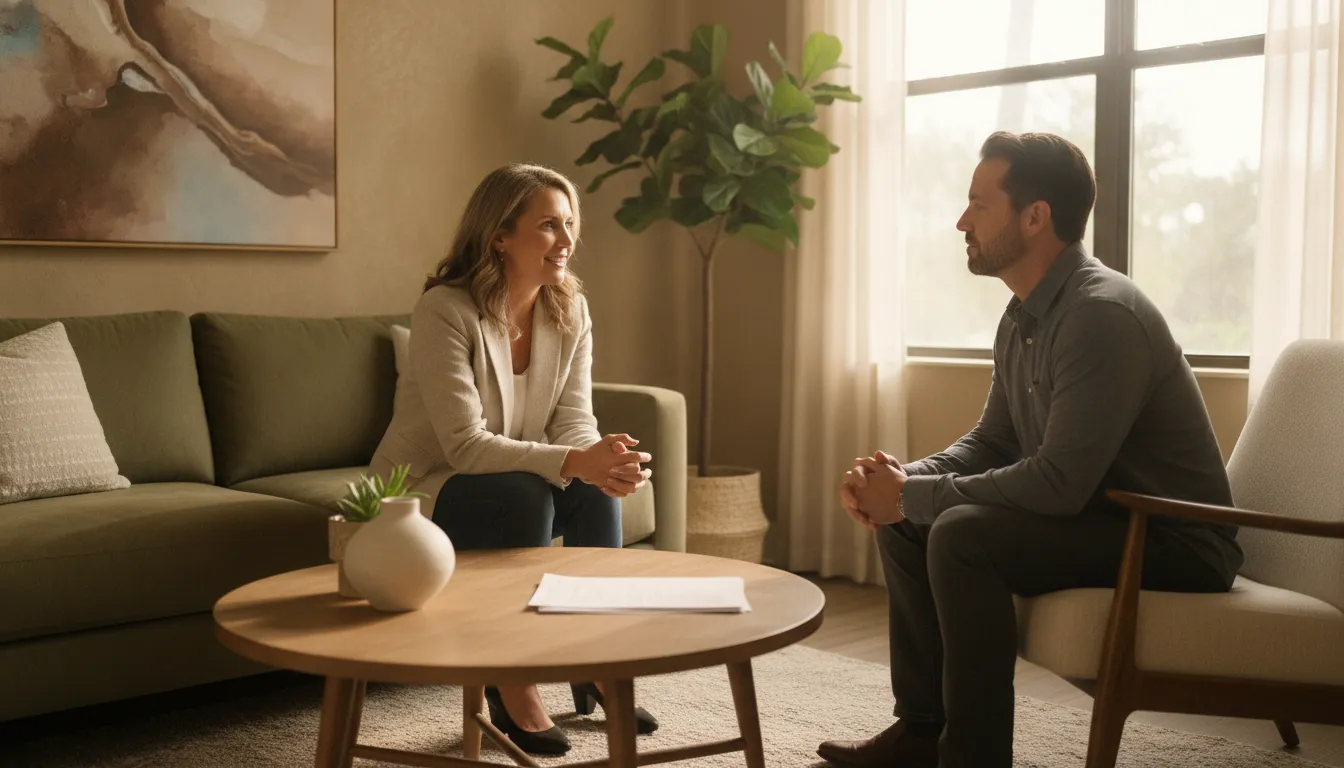
For people who need more structure than weekly counseling but do not require inpatient treatment, CenterPointe describes IOP as one outpatient option. IOP groups are limited to 8-10 participants, which can allow for shared support while keeping the group relatively small. The program may include group and individual therapy, recovery counseling, family involvement, workshops, and medication management when appropriate. Ask the team what format and level of care fit your situation rather than assuming one option is right for everyone.
The Sarasota facility operates inside MindSpa. Details about the setting and local access are available on the Sarasota location page. When reviewing providers, confirm the current clinician’s license, role, relevant experience, and scope of practice. CenterPointe’s staff information identifies Clinical Director Carrie Phelps as LMHC, LMT, and CST-T, with more than 30 years of experience. Those credentials belong to her profile and should not be generalized to every counselor. Insurance coverage and benefits are plan-dependent, so verify details with both CenterPointe and your insurer.
What Are Safe Next Steps When You Are Ready?
When you are ready to explore support, a short, organized conversation can help you decide what to ask for and what to verify. These steps can keep the process practical without assuming that one counselor or format will fit everyone.
- Define what you need right now. Note whether you are seeking individual counseling, group support, help with substance use, support for a co-occurring mental-health concern, or guidance about a more structured outpatient option. You do not need a perfect diagnosis before making an inquiry.
- Call and ask specific questions. Ask about the counselor’s current role, relevant experience, treatment approach, session format, coordination with other providers, and what happens if your needs exceed the program’s outpatient scope. You can also review this first step toward treatment before contacting CenterPointe.
- Verify credentials and fit. Review the provider’s current license or certification with the appropriate credentialing entity. SAMHSA advises checking current credential information directly with that entity. You can also use FindTreatment.gov as a treatment-search resource, then confirm details with the provider.
- Discuss insurance before relying on benefits. Ask CenterPointe and your insurer about network status, eligibility, covered services, deductibles, copays, coinsurance, and prior authorization. Coverage and final benefits are plan-dependent, so do not treat a preliminary answer as a guarantee.
- Escalate urgent safety concerns immediately. If someone may harm themselves or another person, is experiencing a medical emergency, or cannot remain safe, call emergency services or 988 for crisis support rather than waiting for a routine counseling appointment.
Call (941) 488-4811 to discuss your counseling options
Frequently Asked Questions
What is the difference between an addiction counselor and a therapist?
An addiction counselor focuses on substance use, recovery goals, and related support. A therapist may address substance use alongside mental-health concerns. Because training and scope vary, ask about each provider’s license, experience, treatment approach, and ability to coordinate care. SAMHSA explains the range of addiction counseling roles.
How can I verify an addiction counselor’s credentials in Florida?
Ask for the counselor’s full name, license or certification type, and relevant experience. Then confirm current information through the appropriate credentialing entity. A license generally grants legal authority to practice, while a certification does not typically provide independent legal authority, so review both the credential and the provider’s stated scope.
Is individual or group counseling better for addiction recovery?
Neither format is automatically best for everyone. Individual counseling offers private, one-to-one attention, while group support can add shared perspective, structure, and accountability. Ask whether the program can combine formats and how it responds if your needs require a higher or different level of care. CenterPointe offers both individual and group therapy in an outpatient setting.
Does an addiction counselor need to be close to my home in Sarasota?
Convenience matters because regular attendance is easier when travel fits your work, family, and transportation needs. However, local proximity is only one part of fit. Also consider credentials, communication style, cultural responsiveness, privacy, scheduling, and whether the counselor can coordinate appropriate support. CenterPointe’s Sarasota facility operates inside MindSpa.
What should I ask about insurance before starting counseling?
Ask whether the provider participates with your plan, which services may be eligible, and whether deductibles, copays, coinsurance, or prior authorization apply. Coverage, eligibility, and final benefits vary by plan, so verify details with both CenterPointe and your insurer before relying on an estimate. Do not assume that in-network status guarantees payment.